

The Other Guy
When AI displacement and "progress" stops being someone else's problem.


A poll conducted by Epoch AI and Ipsos in early April found that one in five full-time American workers say AI has already replaced parts of their job.
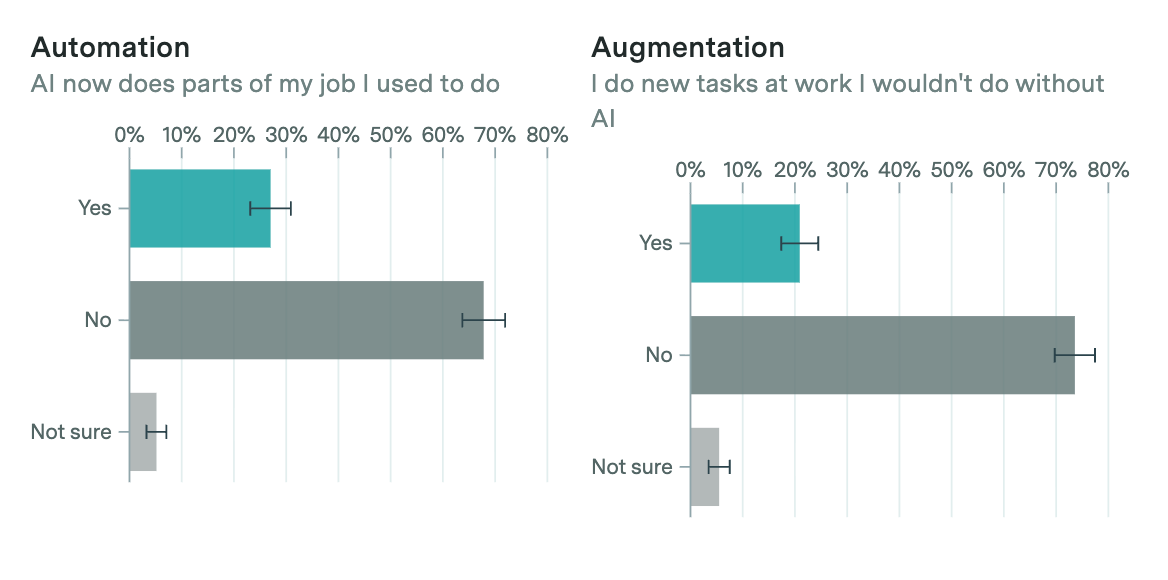
That number reads comfortably as a statistic, until it is your job. Then it reads differently.
Doctor McCoy said it better than any survey can. In “The Ultimate Computer,” a 1967 episode of Star Trek: The Original Series, Captain Kirk watches as his ship, the Enterprise, is retrofitted with M-5, a supercomputer designed to replace human judgment on the bridge entirely.
McCoy turns to Kirk and says,
“We’re all sorry for the other guy when he loses his job to a machine. But when it comes to your job, that’s different. And it always will be different.”
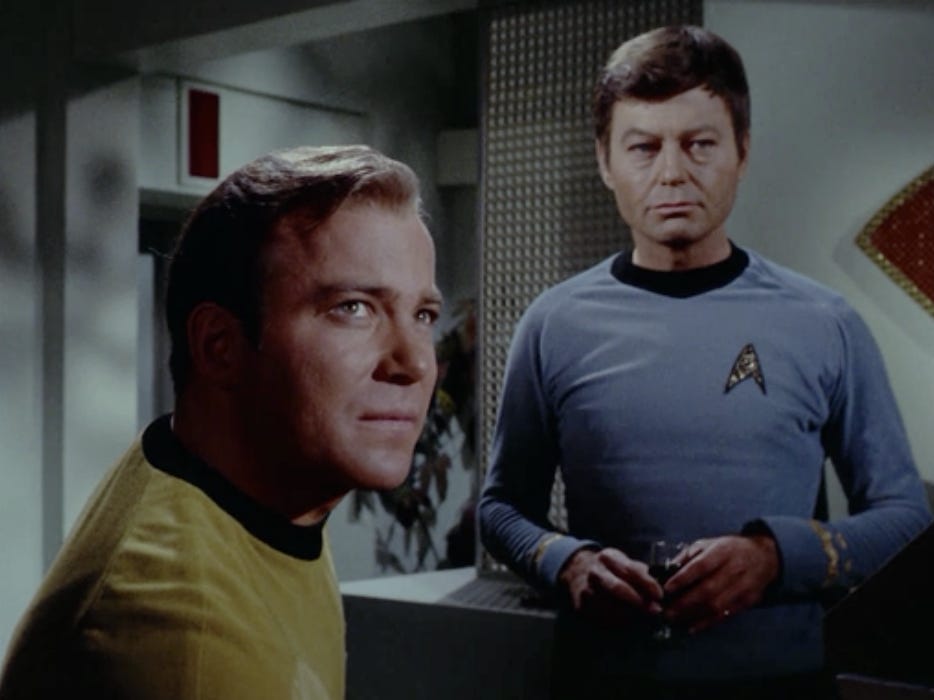
Fifty-nine years later, it is still (per McCoy) different. The names have changed, but the anxiety has not.
The Epoch AI data suggests that AI displacement, where AI leads to less available work for humans, is currently outpacing AI augmentation, where workers become more productive because of AI tools. The gap is real; tasks tend to disappear quietly and well ahead of the titles attached to them, and by the time the title is at risk, the work that justified it is often already gone.
This is not a new story, it just has a new cast.
The printing press did not kill scribes, instead, it killed the economic rationale for scribes. A monk in 1450 who had spent twenty years perfecting his lettering was not argued out of relevance, he was outpaced. The same was true for switchboard operators, bank tellers and travel agents. The work changed, and the value shifted with it.
Most workers do not think of themselves in terms of tasks. They think in terms of roles, titles, and proximity to the work. They assume that being near something important, or having done it for a long time, is the same as being essential to it. That assumption holds, right up until it doesn’t.
What Kirk confronts in that episode is not really a machine. It is a standard. The M-5 does not fail because it lacks power or speed. It fails because it lacks judgment — the capacity to decide when conditions change and the instructions run out. A machine can execute, but it cannot weigh.
That gap is where the conversation about automation tends to get sloppy. A lot of the work being displaced is not being eliminated because it is unimportant. It is being eliminated because it is definable. If a task can be mapped, repeated and measured, it can be handed off. The uncomfortable implication is that many people have built careers around being very good at things that can now be described with enough precision to be replaced.
The question is not whether AI will take your job. The question is whether the value you provide can be reduced to a set of instructions.
Answering that honestly requires looking past tenure and title, past how long you have been near the work, toward what you can actually do that still matters under new conditions. Judgment, synthesis…the willingness to learn new tools without being told and to abandon old ones without resentment. The ability to decide when the inputs are incomplete and the stakes are real. These are the things that don’t reduce cleanly to a prompt, and they are what separates people who navigate transitions from people who get caught in them.
That is what Radical Competency is actually about; not just working hard in a stable system, but remaining valuable when the system stops being stable.
Klarna, the fintech firm, replaced large portions of its customer service workforce with AI, then quietly reversed course months later when the results did not hold up. That is often framed as a failure of AI, though it is more accurately a failure of judgment: the company misjudged what parts of the work required human discernment and what parts did not. The correction did not restore the old system, it redrew the line between what could be automated and what couldn’t.
Some roles will not come back at all; others will return in smaller numbers, and I daresay with higher expectations.
The people who navigate this successfully are not the ones who argue with the change, they are the ones who move toward the parts of their work that are hardest to reduce, hardest to replicate, and hardest to ignore. That requires a level of honesty that most people avoid, because it forces a harder question than what is happening to my job?
It asks, what do I actually do that still creates value?
The episode answers that question before Kirk does. Early in the story, after M-5 runs its first successful battle drill, a rival captain sends a message congratulating the machine and signing off with regards to Captain Dunsel. McCoy doesn’t recognize the word.
“’Dunsel,’ Doctor, is a term used by midshipmen at Starfleet Academy,” Spock tells him. “It refers to a part which serves no useful purpose.”
Kirk just wordlessly walks off the bridge.
That is the fear underneath all of it; not replacement exactly, but irrelevance. Not that the machine beats you, but that the question of whether you matter stops being asked.
The machine does not care how you answer that, nor does it care how long you have been doing the work, or how close you have been to it.
It just keeps moving, at seeming warp speed.