
The Hustle Beyond the Paycheck
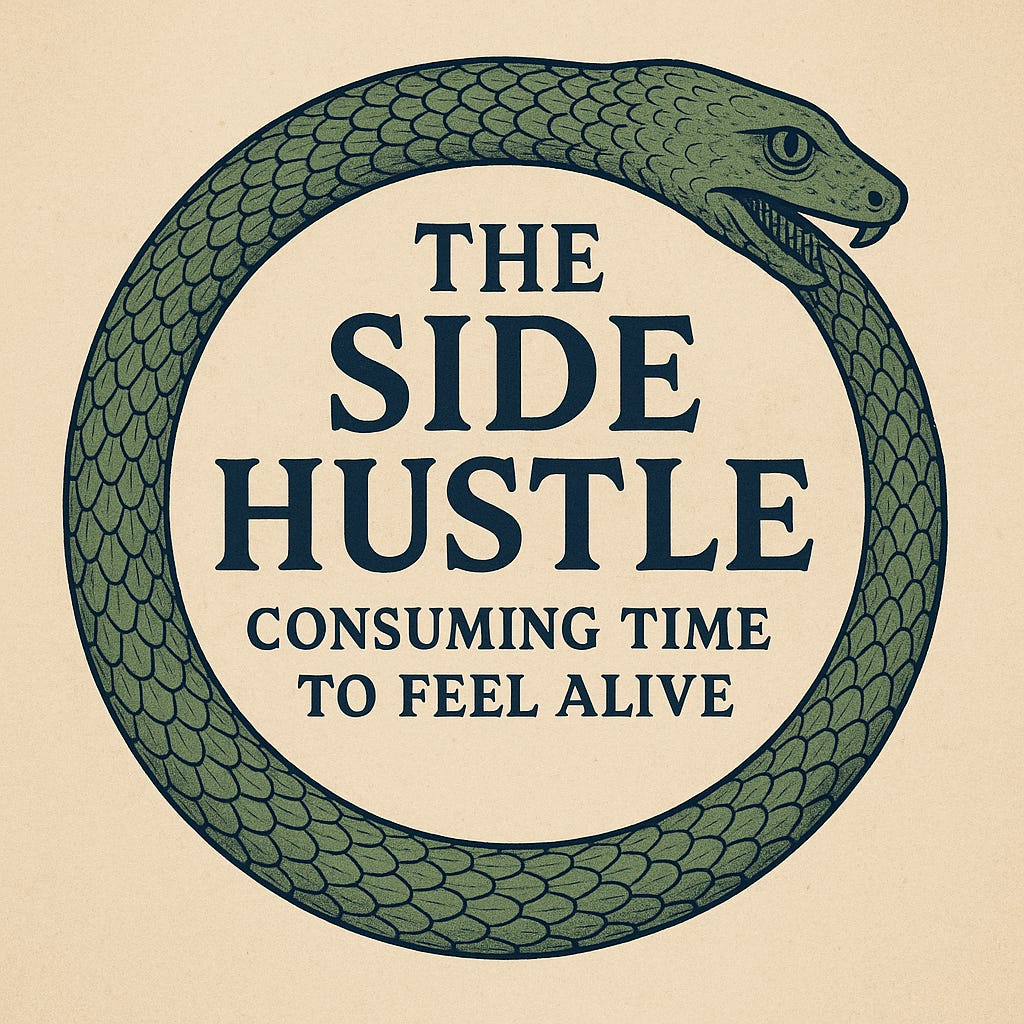
The ouroboros of ambition: consuming time to feel alive.

The other day, while scrolling through LinkedIn between emails, I saw a chart listing the “Top 10 Side Hustles That Work in 2025.” Templates, AI prompt packs, mini-courses, affiliate links. It looked like a digital get-rich-quick quilt. I didn’t click. I didn’t have to. The chart said plenty: everyone’s trying to earn a little more, prove a little more, be a little more.
I get it.
I already have more side hustles than most of the people posting those charts. My full-time job stretches well past fifty hours a week once you add the commute and ping of messages after hours. But I also host podcasts, write essays and novels, publish short stories, consult on communications, and occasionally teach or speak. Somewhere in there, I also try to have a life.
And no, these projects don’t make me rich. Some barely make me lunch money. But they do something more important: they make me feel rich in curiosity, purpose, and the rare satisfaction of seeing something I imagined become real.
Still, sometimes I wonder: are my side hustles a creative outlet or an evasion? A way to express myself, or a way to avoid sitting quietly with my own thoughts? Maybe both. It’s easier to build something new than to stare too long at what already is. And maybe, if I’m honest, every side hustle is a little bit of persona-building, trying to become the person I claim to be. But I’ve never believed you are what you say. You’re what you do. The side hustles, for better or worse, are what I do.
I’m not alone in this. Roughly a third of Americans now juggle a side hustle, earning around $500 a month on average. Most trade away time that used to belong to rest or family. The best-paid gigs are digital or technical: coding, design, marketing. The least profitable are the ones that rely on sheer labor, delivering food, reselling goods, walking dogs.
The more your hustle depends on time instead of ideas, the less freedom it tends to buy. That’s the strange math of it all. We sell our time to buy it back later. Money, in theory, should give us control, but without enough of it, your time is never truly your own. So we keep circling, consuming the same hours we’re trying to free.
For me, the return on investment isn’t money, it’s meaning. My side projects give me something the paycheck usually cannot: curiosity, autonomy, the simple act of making something that didn’t exist yesterday. They let me share what I think, what I’ve learned, what keeps me up at night. I think they make me useful beyond the job description.
And yet, that freedom comes with fatigue. There are nights I stare at the laptop, half-asleep, asking myself why I can’t just watch and enjoy The Lowdown or PLUR1BUS like a normal person. But when I’ve tried to stop, I feel that hollow quiet where the next idea should be. Stillness feels like a void I’m not ready to inhabit.
Maybe that’s the point, though. The side hustle is its own kind of ouroboros, feeding on the same energy it creates, both nourishment and depletion. The ouroboros eats its own tail because it has nothing better to do. Maybe that’s us, consuming the hours we’re trying to save because stopping feels worse than exhaustion.
The ouroboros has long symbolized renewal, the endless cycle of life, death, and rebirth. Maybe that’s what keeps us in motion: the belief that by creating, by building, by filling our hours, we can keep remaking ourselves before time runs out.
Does it matter? I honestly don’t know. But I’ll be back at the laptop tonight anyway, feeding the snake, because the alternative—sitting still long enough to find out—still tasks me more than the fatigue.