


I didn’t feel like writing this today. I did it anyway.
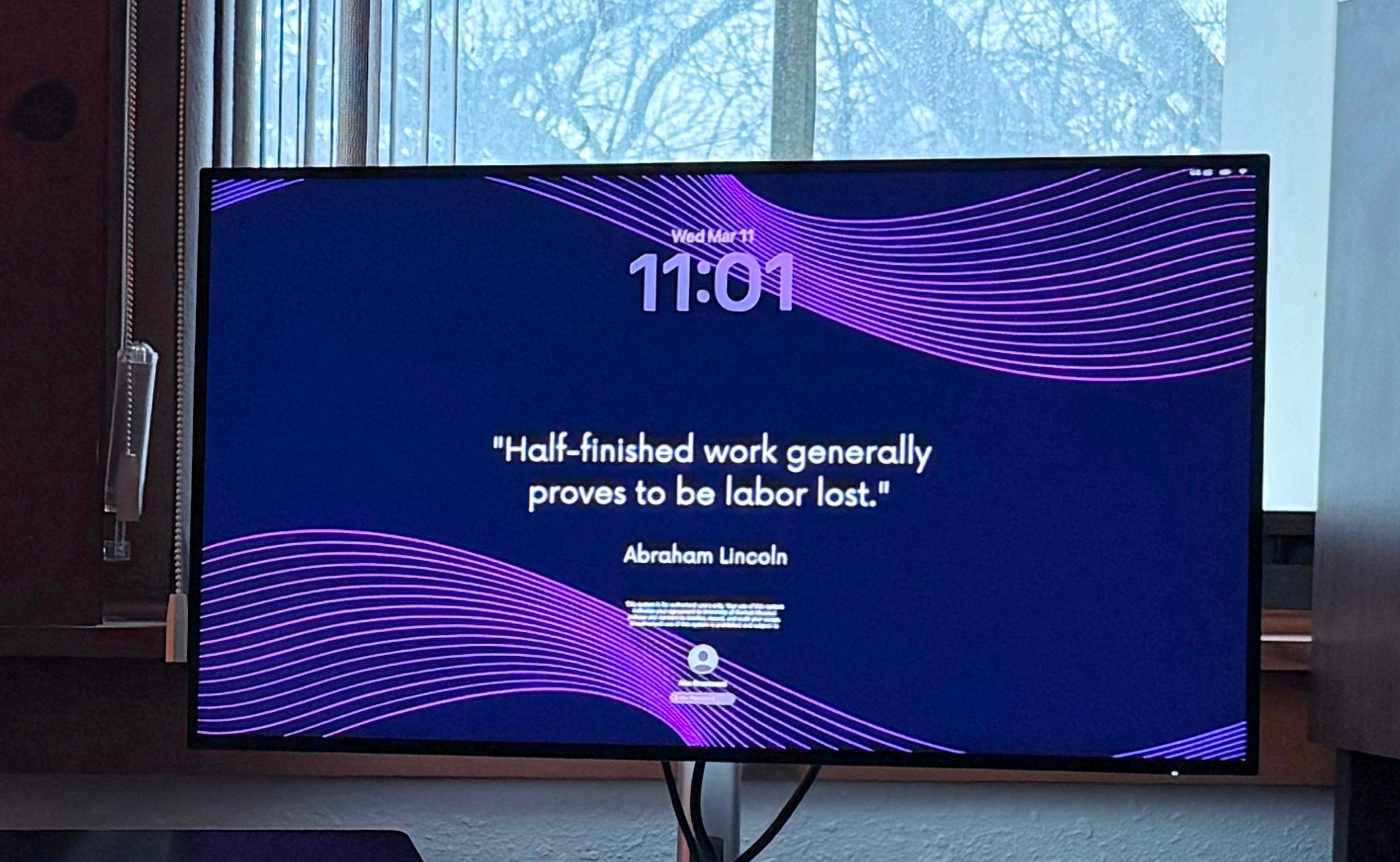
Abraham Lincoln once offered a warning that applies as easily to modern professional life as it did to 19th-century agriculture and infrastructure. Speaking to the Wisconsin State Agricultural Society in 1859, he observed that “the unfinished work of today is the labor lost of tomorrow.” I have a subtly modernized version of that quote on my work screensaver (see above).
Lincoln’s point was simple. Work left undone does not sit patiently waiting for us. Delay compounds the cost. Problems grow, opportunities pass and the effort required later is often greater than the effort required now.
That idea shows up everywhere once you start paying attention.
Projects remain unfinished, organizations remain unfinished, careers remain unfinished. Even the best work we produce rarely feels fully complete. There is always another improvement we could make, another paragraph we could polish, another round of edits that might make the work slightly better.
For many people, this reality creates friction. Unfinished work nags at them, and the discomfort produces anxiety, and anxiety often leads to delay. Delay, in turn, becomes procrastination.
Procrastination is usually described as laziness. In my experience, it almost never is. It is far more often fear. People worry that the work will not be good enough, they worry that others will judge it, or that once the work leaves their control, it will be misunderstood or criticized.
Perfectionism often turns out to be procrastination wearing a nicer suit.
This pattern appears frequently in professional and creative work because releasing work into the world makes it real. Once something is published, delivered, or launched, people can react to it. They can question it, challenge it or build upon it.
The good news is that as long as the work remains on your desk, it cannot be criticized. The bad news is that it cannot do any good either.
Radically competent people approach this tension differently.
They understand that most meaningful work will always remain unfinished in some sense. The goal is not to produce a mythical, perfect version that survives judgment forever. The goal is to move the work forward in a meaningful way.
The marketer and author Seth Godin captured this idea with a simple directive that has become a useful shorthand for many professionals: ship the work.
Shipping the work means sending the memo, publishing the article, releasing the report, making the call or launching the project. The work goes out into the world because it is ready to do its job, even if it could still be improved.
This is not an excuse for sloppy work. Radically competent people care about quality; in fact, many of this stripe, as a matter of course, revise, edit and think carefully about what they are producing. What they avoid is the trap of endless refinement. At some point, they recognize that the work is strong enough to move forward.
In most professional environments, there is rarely time for perfection. A report that is 90% polished and delivered on time often carries far more value than one that reaches perfection two weeks after the moment has passed.
Anyone who has worked in communications learns this quickly. A clear, responsible, and timely statement can shape a narrative; the same statement, delayed while everyone debates the last adjective, may arrive after the conversation has already moved on. In communications, being late is its own kind of wrong.
Radical competency recognizes reality and works within it. Shipping work also creates something else that matters: feedback.
Once work exists in the world, people react to it. Some reactions will be supportive. Others will be critical. Both are useful. They sharpen the next version of the work and help the professional improve more quickly.
Work that remains permanently in draft form never benefits from that process.
The professionals who improve the fastest tend to be the ones who ship consistently. They accumulate experience, observe what works, notice what does not, and adjust their next effort accordingly.
“Perfection is expensive. The last 5 percent of quality almost always costs a disproportionate amount of time and money.” — James Clear
My favorite type of purchase is where you spend 80 percent of the cost, but get 95 percent of the value. The best combination of cost and quality is often one step down from perfect.”
Perfectionists accumulate something else: an impressive, unpublished stack of drafts that nag at their very souls.
That impulse to move work forward rather than wait for perfect conditions does not stay contained to your own output. Genuinely competent people tend to carry it into the work around them, too.
They often feel a quiet sense of responsibility when they encounter something unattended because no one has stepped forward to deal with it. Many people look at these situations and assume someone else will eventually handle them. Radically competent people often react differently; they recognize the unfinished work and begin considering how to move forward.
They are not drawn to unfinished work because they enjoy chaos, but because they see possibility. They understand that meaningful progress often begins when someone is willing to push the work a little further than it currently stands.
Lincoln’s warning helps clarify why this matters. The work left undone today rarely remains neutral, and delay often turns a manageable effort into a much heavier lift later.
In professional life, the same pattern appears constantly. Problems grow while people hesitate. Opportunities fade while teams debate minor details. Work that could have moved forward stalls because someone fears releasing it before it feels perfect.
Radical competency resists that pattern. Competent professionals accept that judgment will come and understand that improvement comes through movement, not hesitation. They release work when it is strong enough to do its job, then refine the next version with the benefit of experience.
No career, project, or institution ever reaches a final state of completion. The responsibility is simply to move the work forward.
Most work does not need to be perfect. It needs to be finished, useful and moving before today’s unfinished work becomes tomorrow’s lost labor. If that message gets lost in the shuffle, on your desk, I recommend putting Lincoln’s quote on your screensaver.
Or this one:
“Your habits will hold you back more than your enemies ever will. Which is good news because you can change your habits. You can’t change your enemies. Stay focused on what you can control.” — James Clear