
A Modest Holiday Wish
No reset button under the tree.

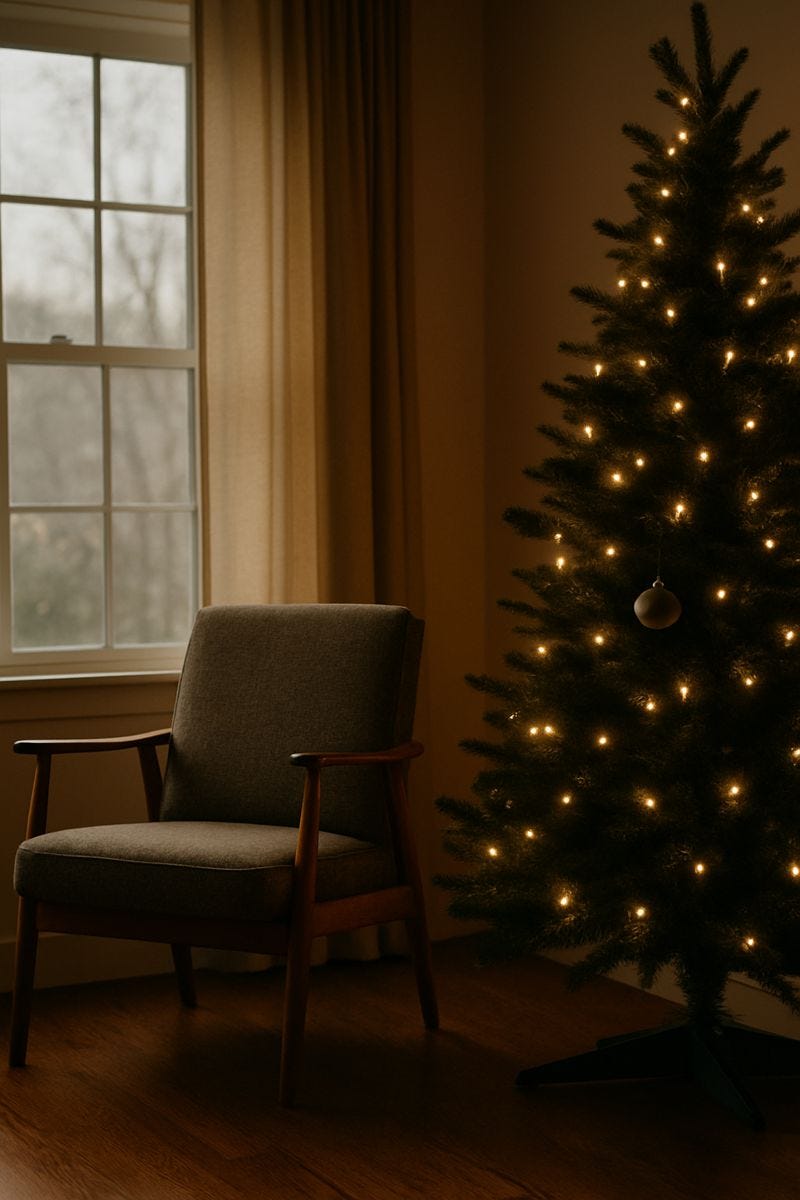
I am not going to tell you that the holidays are a reset button.
I am not going to pretend that the calendar flips, the noise dies down, and we all emerge wiser, calmer, more united. I am not going to claim that this year “taught us” something profound that last year somehow missed. We have been taught plenty. Repeatedly. Often loudly. Learning, as it turns out, is optional.
This is the time of year when hope is treated like a civic obligation. You are expected to believe, to feel uplifted, to post something earnest about light in the darkness. It is well intentioned. It is also usually hollow. Hope, when issued as a press release, rarely survives contact with reality.
So this is not that kind of piece.
It is December. People are tired in ways they do not have language for. The volume has been high for a long time. Everything is urgent. Everything is framed as existential. Everyone is certain. Meanwhile, the work that actually matters still gets done quietly by people who do not announce themselves, who do not perform concern, who do not confuse conviction with competence.
Those people are still here. That matters.
I am wary of wishcasting. I have seen too much of it. The idea that if we just want something badly enough, or declare it loudly enough, the world will bend toward it. That belief has done real damage. It lets people substitute belief for effort, slogans for systems, vibes for responsibility. It rewards those who sound confident, not those who are careful.
This past year included a season of profound personal loss. Not the kind that arrives with tidy meaning attached, and not the kind that asks to be redeemed by insight. Just the kind that rearranges the furniture in your head and leaves you moving more carefully through rooms you thought you knew.
It did not make me wiser. It did not clarify everything. It did, however, make me far less patient with empty optimism and far more attentive to what actually holds when things go quiet. Loss has a way of stripping language down to what earns its keep.
Which is one reason I am suspicious of hope offered too easily, especially this time of year.
And yet, I am not without hope. I just prefer mine small, specific, and earned.
Arthur Conan Doyle put it more elegantly, through Sherlock Holmes: “It has long been an axiom of mine that the little things are infinitely the most important. Never trust to general impressions, my boy, but concentrate yourself upon details.”
That has always struck me as less a detective’s trick than a survival strategy.
Here is what I am willing to wish for.
I wish for clearer thinking in smaller rooms. Fewer grand pronouncements and more honest conversations where decisions actually get made. I wish for people to say I don’t know without shame and I was wrong without theatrics. Those two sentences, spoken sincerely, would improve a shocking number of outcomes.
I wish for fewer bullies masquerading as truth-tellers and fewer cowards hiding behind process. Strength is not volume. Integrity is not rigidity. Leadership is not the absence of doubt. We have confused confidence for competence for so long that many people no longer recognize the difference. I would like that to change, even incrementally.
I wish for a little less casual cruelty. Not the headline kind, but the everyday version, mostly performatively enacted on social media. The drive-by comment. The pile-on. The reflex to humiliate instead of persuade. None of this is inevitable. It is chosen. It can be unchosen. Not all at once, but person by person.
I wish for people to tend their own gates as carefully as they tend their gardens. To take responsibility for what they let in and what they send out. To understand that boundaries are not walls, they are filters. They make growth possible. They make rest possible. They make honesty survivable.
I wish for competence without permission. For people who see a mess and quietly start cleaning it up. For those who prepare when no one is watching, who think through second-order consequences, who understand that real work is often unglamorous and frequently invisible. Civilization runs on these people. So do organizations. So do families.
I wish for better questions. Not louder answers. Questions that slow things down just enough to keep us from driving off the road at full speed. Questions that assume complexity instead of denying it. Questions asked in good faith, which is rarer than we like to admit.
These are modest wishes. They will not trend. They will not fit on an ornament. They will not fix everything.
But they might fix something.
This year, writing has continued to be the place where I can make sense of things without pretending they are simpler than they are. It is where I get to think out loud, revise myself, and occasionally catch my own bad habits before they harden into something permanent. If you have been reading along, whether quietly or with notes in the margins, I am grateful. Thoughtful readers are not a given. They are a gift.
I know this season can be complicated. For some, it is warm and loud and full. For others, it is sharp-edged and lonely. For many, it is both at once. There is no single correct way to feel your way through it. Anyone telling you otherwise is selling something.
If you celebrate Christmas, I wish you a Merry Christmas. Not a perfect one, just a good enough one. If you celebrate something else, I wish you the same. And if you are simply trying to make it to the other side of the week with your dignity intact, that counts too.
The future will not be saved by belief alone. It will not be rescued by declarations, resolutions, or slogans. If it improves at all, it will be because enough people chose attention over noise, competence over theater, restraint over rage.
That is not a grand promise. It is not guaranteed.
But it is available. And for now, that feels like something worth wishing for.
I'll revisit this "wish list" often. Thanks! I had an advisor, once, who said that the best gift we can give ourselves is to be careful about what we read, view, are exposed to. Not that we should avoid the new and challenging, but that we should avoid the useless anger, what we now call rage-bait.